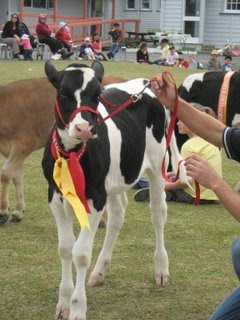
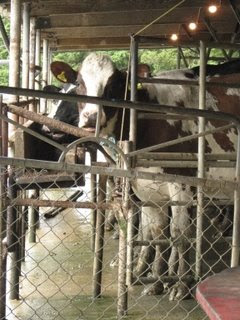
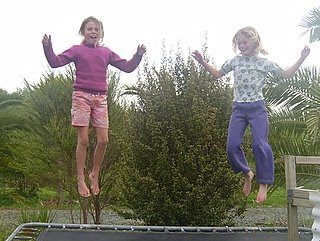
Inaya & Michelle despite their worries over the calves ended up having a great day and lots of ribbons with it. We have Anne to thank for that. Michelle's calf is an Ayrshire named Starlight and Inaya took Charlotte a Fresian. Happy kids and happy calves - what a great day!!!
2008-11-01
Inaya & Michelle on Pet Day
Inaya & Michelle despite their worries over the calves ended up having a great day and lots of ribbons with it. We have Anne to thank for that. Michelle's calf is an Ayrshire named Starlight and Inaya took Charlotte a Fresian. Happy kids and happy calves - what a great day!!!
Maungaturoto Primary School Pet Day- Champion Senior Calf & Champion Senior Heavy Dairy
Maungaturoto Primary School Pet Day - Champion Junior Calf
Spotted around the Garden
While I'm working on the huge number of photos I took yesterday...I found these images I took earlier this year. The first one is the introduced Song Thrush and the other which wouldn't stay still long enough for me to get a really decent shot is of a New Zealand Kingfisher sitting on the flax flowers. We have so many different bird species around the farm here. I'm still trying to photograph them all but I need one of those big fancy cameras the wildlife photographers have to get decent images.
2008-10-31
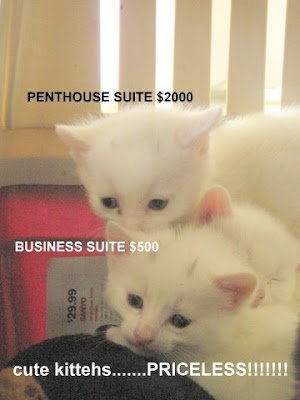
Priceless Moments
Pet Day today has been great. The kids came home with lots of ribbons and certificates and I got lots of photos. So many I thought I'd upload a few at a time. These little kitties were in amongst the small pets and they were so cute. I just had to take a photo (actually several).
Not So hot off the Press - Agresearch Media Release 29th October Horizons Conference
New Zealand Pastoral & Food sectors need to aim for niche markets, says Fast Forward Fund Chair
The Chairman of the Fast Forward Fund Board, Bill Falconer, says that if New Zealand pastoral and food products are to compete on the global market, a focussed collaborative effort between the Government’s research provider agencies and business is needed, starting with the identification of gaps in the market.
Speaking at the Horizons in Livestock Sciences Conference, jointly presented by AgResearch and CSIRO (Commonwealth Scientific and Industrial Research Organisation) Livestock Industries in
He says central to the growth of
“The key is to determine ways of adding value to our capability, of moving our products up the value chain and to find out what the market wants, rather than making more of what we can produce.
“If we are to grow, our people need resources to work with and something to sell,” he says. “While
Bill Falconer says this requires a quantum shift in the way in which
He says
The Fast Forward Fund is aiming at establishing programmes between the government and the private sector which will address all the requirements needed for its pastoral and food industries to compete on a global market.
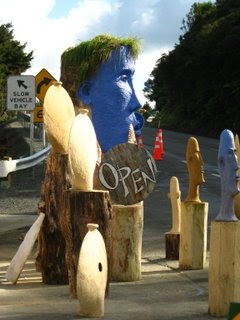
Hey What's Barak Obama doing here in Maungaturoto???
"Excuse me sir...but aren't you supposed to be running for US President??" Answer......there isn't one. Yeap this guy was the bouncer on the door to keep the small pets safe from being mauled to bits by the kids. Ah...I think someone should call his Campaign Manager? I took the photo after Danielle (she's Canadian) one of the Mums, had stuck him on the chair with the hat on. Never noticed until I downloaded the images off the digital. I saw the funny side to it. Whats this guy doing in a small rural New Zealand Town like Maungaturoto? Heck he would have had to take one very big pay cut. From Politician to Pet Day Bouncer? The mind wonders.....
Hot off the Press-NZ Dairy Industry Awards Trust - 2009 Dairy Awards Calling for entries
ENTRIES OPEN IN 2009 DAIRY AWARDS
The New Zealand Dairy Industry Awards are now calling for entries in its 2009 competitions from sharemilkers, farm managers and dairy trainees keen to progress in the industry.
National Convenor Chris Keeping says organisers hope more than 400 dairy farmers will enter the three competitions – the Sharemilker of the Year, Farm Manager of the Year and Dairy Trainee of the Year - nationwide.
She says this is just the second time the New Zealand Dairy Industry Awards has run the three competitions, culminating in national finals for all three.
“The awards are now structured to enable people to progress through the awards as a person progresses through the dairy industry – from farm worker to farm manager to sharemilker and ultimately farm ownership.
“At the same time, we seek to encourage best practice and the sharing of excellence and also identify and promote the dairy industry’s future leaders,” she says.
“We also like to have a lot of fun, as past entrants and winners can testify.”
Ms Keeping says there are significant incentives on offer for dairy farmers to enter.
“There are thousands of dollars and other prizes to be won, significant recognition to be gained from success and a lot to be learnt from entering – either from judges, other entrants and industry or sponsor representatives that entrants network with.”
The Dairy Industry Awards are supported by national sponsors Westpac, Blue Wing Honda, DairyNZ, Ecolab, Federated Farmers, Fonterra, LIC, Meridian Energy, Ravensdown and RD1, along with industry partner Agriculture ITO.
Ms Keeping says entries are invited for the three awards within the 12 regional competitions that cover the entire country.
The regional competitions can offer prize pools in excess of $50,000, with the three regional winners all progressing to the national finals and the opportunity to be named New Zealand Sharemilker of the Year, New Zealand Farm Manager of the Year or New Zealand Dairy Trainee of the Year.
Entries close in early January, with entry forms available from regional convenors, sponsors or downloaded from the awards website, www.dairyindustryawards.co.nz.
2008-10-30
Hot off the Press -Agresearch Media release -Conference warned of Future threat to Dairy Industry
30 October 2008
Speakers at the Horizons Livestock Sciences Conference in Christchurch this morning left no doubt that Dairy will remain one of the fastest growing industries in New Zealand, but one speaker warned that the global dairy industry would eventually face some fierce competition from the soybean industry.
Addressing the question of “Value vs Volume”, the Managing Director and CEO of the Synlait Group, Dr John Penno, said soy as a protein substitute would influence the dairy industry in the future, unless the industry could find ways to transform the value of its product. “Soy can be produced much more efficiently on scales we can’t even comprehend, and as soy products are being developed to more and more resemble dairy products, there is a danger that it can become a substitute for most dairy products.”
Dr Penno says New Zealand’s dairy industry will have to find ways that can meaningful differentiate its products from others on the international markets. “This is a 20 year strategy. We need to exploit the bundle of benefits that is uniquely New Zealand – things that we take for granted like a healthy environment, healthy lifestyles and healthy and safe food. All of these attributes have to be wrapped up in real products with substance,” he says.
He says there is a challenge ahead for scientists working on adding value to dairy food products. “We are going to compete with an easier to produce and cheaper soy product. You have to start working now on the results we need to make sure our dairy products remain the consumers’ choice.”
Putting aside the potential threat of soybeans to the dairy industry, the future of the industry seems to be bright. Both Dr Penno and Fonterra Milk Supply Director, Barry Harris agree that the global demands for dairy products are growing at a healthy rate.
Therefore, says Barry Harris, that while it is also necessary to increasingly look at ways to add value to the product, volume will remain critically important to the dairy industry’s success in the future.
About 150 scientists and agribusiness leaders from Australia and New Zealand are attending the three day conference in Christchurch, which is jointly hosted by AgResearch and CSIRO (Commonwealth Scientific and Industrial Research Organisation) Livestock Industries.
Hot off the Press- Agresearch Media Release Geriatric Designer Diets visiting US Expert Dr Henry Zerby
Development of Geriatric Designer Diets
29 October 2008 - Date corrected
A visiting American expert in Animal Sciences says there is growing focus on developing foods for geriatrics.
Speaking at the Horizons science conference in Christchurch today, Dr Henry Zerby from Ohio State University's Department of Animal Sciences said the increasing ageing population is leading to the emergence of geriatric designer diets.
"An important part of this is developing meat for the elderly. They need meat which is easy for them to chew and swallow as their salivary glands start to wear out. Researchers are developing such meat which can also contain added zinc and iron to ensure the elderly obtain the levels of these micronutrients they need. The meat needs to be easily masticated but still desirable in appearance and flavour," said Dr Zerby.
"In America some nursing homes for the elderly are already using designer geriatric meal plans to attract elderly people. It's part of their marketing.
Dr Zerby says New Zealand meat is already well placed to develop the properties desired for geriatric diets.
"It is beneficial for the elderly to eat meat but meat is in the middle of a battle ground about health. There is a negative image related to the fat it contains but not all fats are created equal. Polyunsaturated fats have health advantages and these are generally found in greater concentrations in the meat of grass fed animals.
"New Zealand meat, with its grass fed lamb and beef, is often already leaner than the meat produced by grain fed animals and contains elevated levels of desirable fatty acids which can have anti-carcinogenic and anti-obesity properties.
"However, to ensure that meat eating is healthy it is important to control portion size. The recommended daily portion size of meat consumed should be similar to that of a pack of cards. If this amount of meat is consumed it is both safe and healthful as long as other aspects of a person's diet are appropriate for age and lifestyle," said Dr Zerby.
Dr Zerby is one of the international speakers addressing the Horizons conference which is sponsored by AgResearch, New Zealand's principal pastoral food research institute, and the CSIRO (Commonwealth Scientific and Industrial Research Organisation) Livestock Industries Division.
2008-10-29
Gobble Gobble Gobble
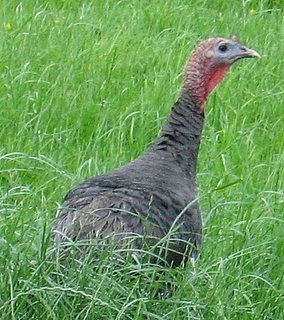
The local turkey population around the farm here has got a bad case of the gobbles. I hear them constantly since it's spring and the Tom Turkeys are out with the hens. I took these photos last year of a hen turkey on Terry's farm next door - you can just make out her newly hatched chicks in the grass.
2008-10-28
Press Release - NZ Agresearch on the global Crisis
AgResearch Media Release -global financial crisis impacts
Global financial crisis means tough times for biotechnology sector
28 October 2008
AgResearch, New Zealand’s principal pastoral food Research Institute, and Australia’s CSIRO (Commonwealth Scientific and Industrial Research Organisation) Livestock Industries Division today predicted the global financial crisis could significantly reduce investment in biotechnology and agricultural science.
At the opening day of their joint three day Horizons science conference in Christchurch AgResearch's General Manager of Applied Technologies, Dr Jimmy Suttie, said there's likely to be a low appetite for investment in the biotechnology market from now on.
"The international financial crisis means there is a low appetite for risk and less likelihood of investment in areas such as animal biotechnology. However, this investment is important for New Zealand's future," said Dr Suttie.
"Additionally, if farmers face a downturn it becomes an instant issue for AgResearch. As tougher economic times develop farmers will want increasing real value from what's delivered by the sector levies they pay. AgResearch receives significant funding from sector levies and should this disappear AgResearch would face financial repercussions."
Meanwhile CSIRO Livestock Industries Division Chief Professor Allan Bell said it can't be foreseen just how big an impact the financial crisis will have on national science budgets in Australia and New Zealand.
"The situation is gloomy and all bets regarding the future are off," he said. "Both Australia and New Zealand are affected by export markets and how the international financial crisis affects other national economies. The next couple of years will be pretty tough."
Dr Suttie predicts the biggest single issue facing New Zealand agriculture is changing land use, with dairy farms replacing sheep and beef farms on high quality land.
"Dairy and crop farming will predominate with crops being mainly raised to feed diary herds. Sheep will have to move onto poorer quality hill country which will require more fertiliser while the beef industry will have a change in the quality of animals it has for processing.
These issues are part of the focus of the Horizons conference which is: the future of agriculture: value or volume? The conference aims to generate robust debate on the future for trans-Tasman livestock industries, especially in light of increasing global concern about food safety.
Talk to the Big Giant Head about it
Apparently I'm not following any blogs any more first I knew about it and you guys do not exist....so I've decided to go and talk to the Big Giant Head and find out what the score is. As usual the Big Giant Head is too busy ruling over the smaller heads to be bothered with me. I now have the answer and the problem will be fixed today or I will unleash my bull into their headquarters and see if things get fixed sooner. Just to let you guys know I will make it over to comment on your blogs - or I will pay my ISP provider a personal visit......just kidding. Actually Chris made this out of clay and someones kid broke the lips off it later on.
Charlie Causer with Dancer

This is another of Allans precious photos. The man on the horse is named Charlie Causer. His horse Dancer could do all sorts of tricks as well being a top show jumper in the 1930's. Charlie enlisted during WW II and lost a leg. Dancer was sold to someone else and sadly died from an accident. I think this photo is fantastic.
2008-10-27
Spring Flowers
3 months old and still a Terrorist!!!
The Terrorist is now three months old and doing her usual terrorist activities of eating mummy's plants and the chickens tail feathers. She reminded Mum it was bottle time or more chickens would be chased around the house. She is still very cute and tiny not a prize winner as far as a jersy goes but who cares. We love her all the same.
How it looked in the fifties on Pet day in Maungaturoto
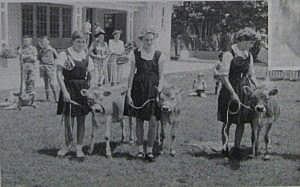
Our School Pet Day sadly ended up being postponed because of the weather turning lousy. the kids are looking forward to this coming Friday to finally get a chance to make good on all the hard work they have done with their calves. I'll never hear the end of it if the rain shows up and spoils it yet again. I'm currently digitising some of the local Maungaturoto History books. I found this image of Calf Club day at Maungaturoto Primary taken in the 1950's. Gymn frocks - oh no!!! You don't see those any more thank goodness. I've included a photo from last year's Pet Day in 2007 for a comparison. How times have changed
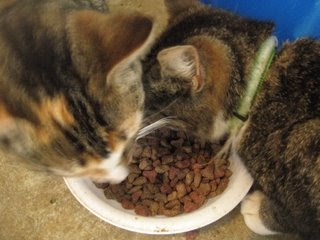
Cat Apartment Block
2008-10-26
Off the Farm - Kauri Tree Gum display at the Matakohe Museum
I visited the Matakohe Museum earlier this year just to take photos. They have a fantastic display covering the Kauri timber industry as well the gumdiggers that used to dig up Kauri gum for a living. A lot of it was shipped overseas during the nineteenth century to be used as glue. These days people make jewellery out of it. The snail shell in the photo is a Kauri Snail. These big snails are now rare and not found in very many places. They are also carnivorous and don't eat Kauri trees!