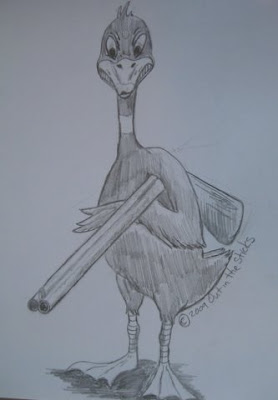
2009-05-02
Watch out Kiwi Duck Hunters ....Daffy has a gun!
Opening morning here for the start of the New Zealand Duck Shooting Season. I heard a couple of shots this morning - but the weather well is less than friendly to the hunters today. My big dam down the back of the farm will be filling up with ducks over the next few weeks...
2009-05-01
Legalise tiger trade to save species, economist urges or did he really say that?
A large part of the problem with this article is simply, tiger farming isn't what the research about. I wrote two lines about tiger farms in a paper that actually detailed the organisation of the black market in tiger products. That's what the research was about.
Nothing to do with Keynesian economics, and a fair bit about me putting my arse on the line in smuggling hot-spots.
The poaching problem is that it has many tiger populations on the fast-track to extinction. That hasn't changed in a long time.
TV3 News has written a more accurate view of Brendan Moyles' paper and research into the Black Market Trade in China. At no point in my own reading of the early draft version is there any suggestion that Tiger Farming was an option. It was mentioned in a brief sentence as being an option by the Chinese Government however there was strong opposition to this. I haven't read the final paper but going on the early draft version at no time does Brendan Moyle make any of the suggestions the Herald report below has reported. I would suggest reading the TV3 News Item concerning Dr Moyles Paper on the Black Market Trade in China.
Legalise tiger trade to save species, economist urges
4:00AM Saturday May 02, 2009By Lincoln Tan

Brendan Moyle argues a market-driven approach is the most effective way of saving the tiger from extinction. Photo / Paul Estcourt
Massey University lecturer Brendan Moyle is on a one-man mission to save the tigers.
After a "secret mission" to uncover the truth behind the illegal trade in tiger products in China, the wildlife economics expert says the only way to save the animal from extinction is to legalise the tiger trade and convince the Chinese that the big cats "can make them a whole lot of money".
The trade in tiger parts has been subject to an international ban since 1987 and has been outlawed in China since 1989, but Dr Moyle says conservation and legislation have not worked and wants to see tigers farmed and trade in them legalised, just like crocodiles.
"In the 1970s, two-thirds of crocodiles [species] were endangered. Now only one-third are, and this is largely because we have legalised the trade and turned them into handbags, belts and by putting them on the menu," Dr Moyle said.
"When we go to the locals telling them that crocodiles are worth a lot of money, we get more crocodiles. What we should be doing now is going to the Chinese and convincing them that tigers are also worth a lot of money."
Dr Moyle, who has made three visits to China for his covert operation, wants tiger farming "back on the discussion table" because it would also prove to be the most sustainable option to satisfy demand without threatening the wild tiger population.
"Conservationists are failing to get to grips with the market drivers. The issue is about markets, not about zoology. This is the way to save the species," Dr Moyle said.
"Tiger farming is not the feel-good solution, but we farm crocodiles, deer, salmon, so what makes tigers so special?
"The potential benefit is that it may cause some consumers to leave the black market and switch to legally sourced ones."
China is one of the world's biggest markets for tigers, which are prized for their skin and body parts, especially bones, which some Chinese believe to be effective in treating severe bone diseases. A whole tiger can fetch up to $90,000.
Despite global conservation efforts, which Dr Moyle says cost $177 million a year, the numbers continue to decline, mostly because of illegal hunting and human encroachment.
The World Wildlife Fund estimated last year that there were only about 3500 tigers left in the wild, compared with 100,000 at the start of the 20th century.
Education will be ineffective because the Chinese have used tiger parts for centuries, Dr Moyle said.
Dr Moyle has prepared a paper, which has been published in the journal Global Crime, saying there is no single black market for tiger products, but rather a market with geographical separation for two products - skin and bones.
Since the 1980s, a number of tiger farms have been set up in China and are believed to house 5000 captive tigers - possibly more than those which remain in the wild.
But some international conservation groups, such as the Environmental Investigation Agency, remain opposed to farming tigers as a means to combat poaching. They argue it would be cheaper to kill a wild tiger than to rear a captive one.
NZ Customs investigations manager Terry Brown said trading detected here involved mainly birds and reptiles, not tiger parts.
TIGERS
* Only 3500 left in the wild compared with 100,000 at the start of the 20th century.
* Hunted and poached for their skin as well as their bones, which are used in traditional Chinese medicine.
* Trading in tiger parts subject to international ban since 1987 and outlawed in China since 1989.
How to save the tigers:
Lift the ban, encourage more tiger farming and convince the locals that tigers "are worth a lot of money".
2009-04-30
Walking my ....Cow?
2009-04-28
Fonterra is the toast of dairy farmers - Payout up $5.20
“The ten cent revision may not sound like much, but for the June payment, it will represent some $120 million welcome dollars,” says Lachlan McKenzie, Federated Farmers Dairy chairman.
“This news comes at a time when many dairy farmers have dried off their animals ahead of winter, or due to a lack of feed resulting from a drier than expected autumn.
“Due to changes in Fonterra’s payout structure, many farmers would not have had any substantive income until September or October. You can imagine that since dairy farmers have to pay wages, electricity, provide winter feed and of course, put food on the table, this revised payout forecast is welcome news.
“The upwards revision backs Federated Farmers’ view that Fonterra, rightly, erred on the side of caution when it undertook the revision in January.
“This increasingly confirms the view that dairy has reached the bottom of the cycle.
“Banks should not have any doubt that dairy remains an excellent business to be in for well-run farms. The banks must end a mini-liquidity lock that is affecting farm businesses and sharemilkers. Farmers also look at the margin between 90-day bank bills and their financial facilities and ask who is farming whom.
“Farmers, meanwhile, must speak to their farm advisers, accountants and even the bank in an open book fashion to ensure they remain viable businesses.
“Clearly, Fonterra’s upwards revision is not good news for the doomsayers. Although growth maybe slow in the short term, it’s a positive sign for the medium term that will bring cheer to many farmers.
“It has also broken the run of bad news.
“We may not be able to afford champagne but we’ll be toasting this with a glass of milk tonight,” Mr McKenzie concluded.
This was worth waking up for
2009-04-26
Declawing - a sore point
Veterinarian Christianne Schelling D.V.M describes declawing or Onychectomy Surgery as follows:
"Declawing is actually an amputation of the last joint of your cat's "toes".
When you envision that, it becomes clear why declawing is not a humane act. It is a painful surgery, with a painful recovery period. And remember that during the time of recuperation from the surgery your cat would still have to use its feet to walk, jump, and scratch in its litter box regardless of the pain it is experiencing."

In the wild claws for large feline predators are essential as both defence and a means in which to effectively hunt, bring down and kill their prey. Declawing effectively removes both their ability to both defend themselves and for having any change of future release through a rewilding programme.
Barbary Lion Shia at Zion Wildlife Gardens
"A major concern that the AVAR has about declawing is the attitude that is evident in this situation. The cat is treated as if he or she is an inanimate object who can be modified, even to the point of surgical mutilation, to suit a person's perception of what a cat should be. It would seem more ethical and humane to accept that claws and scratching are inherent feline attributes, and to adjust one's life accordingly if a cat is desired as a companion. If this is unacceptable, then perhaps a different companion would be in order."
Below is a detailed description of how a cats anatomy is constructed for balancing on its toes and the effects declawing can have..Unlike most mammals who walk on the soles of the paws or feet, cats are digitigrade, which means they walk on their toes. Their back, shoulder, paw and leg joints, muscles, tendons, ligaments and nerves are naturally designed to support and distribute the cat's weight across its toes as it walks, runs and climbs. A cat's claws are used for balance, for exercising, and for stretching the muscles in their legs, back, shoulders, and paws. They stretch these muscles by digging their claws into a surface and pulling back against their own clawhold - similar to isometric exercising for humans. This is the only way a cat can exercise, stretch and tone the muscles of its back and shoulders. The toes help the foot meet the ground at a precise angle to keep the leg, shoulder and back muscles and joints in proper alignment. Removal of the last digits of the toes drastically alters the conformation of their feet and causes the feet to meet the ground at an unnatural angle that can cause back pain similar to that in humans caused by wearing improper shoes.
For the big cats at Zion the decision made for them was nothing short of inhumane. I put it to those who have followed the Lion Man Series to defend this practice as being justified. Would they do this to their own adored pets? I doubt it. And while the many fans are ready and willing to defend the man behind the series in his bid to regain control over the park and the animals concerned - are they willing to read this post and see what the Zion Big Cats had to endure in order to perhaps make them less dangerous. The reasons behind that decision I truly don't know but my opinion is - it was the wrong decision to make and a bad one at that.A blogger in the UK and a former veterinary nurse has kindly provided this petition link to have declawing banned. She felt strongly enough to leave a comment and tell me how she felt. I concur.

Further Reading: Declawing: What you need to know